
Starlink vs 5G for RV Internet: Which Is Best for Full-Time Travel?
If you’ve been researching internet for your camper van or motorhome, you’ve probably found yourself stuck between two options: Starlink satellite internet and a 5G mobile internet setup.
Both are excellent solutions, but after years of travelling and building multiple camper vans, I’ve learned that choosing the right option depends entirely on how you travel.
The good news is that there isn’t really a wrong answer anymore. Internet on the road has improved dramatically in recent years, and both systems can provide speeds that were almost unimaginable just a few years ago.
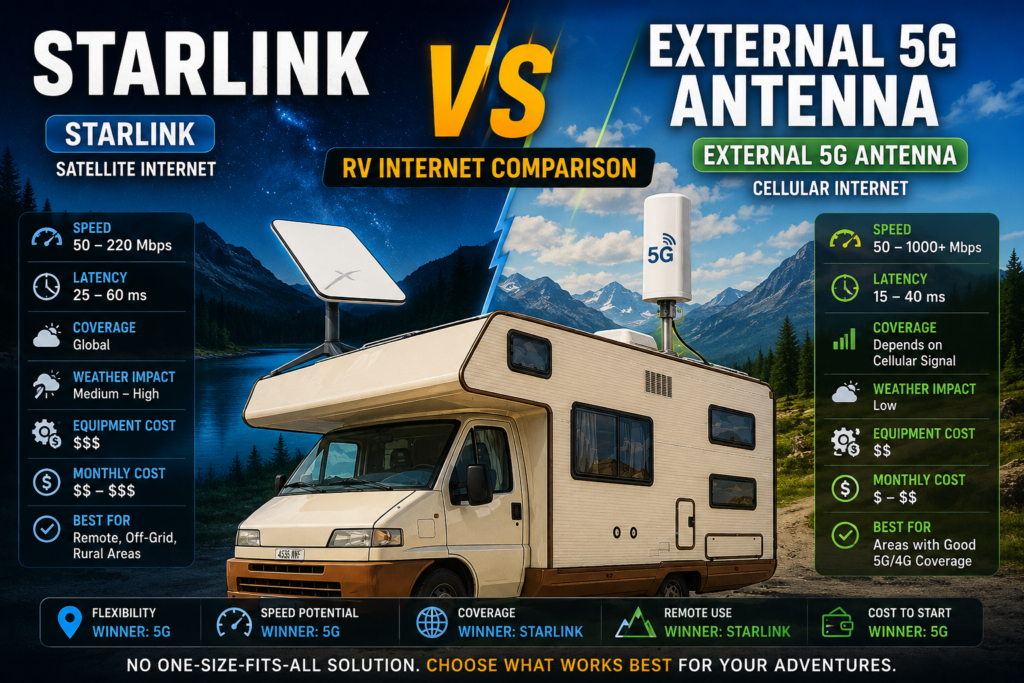
The Case for 5G
For most travellers, I believe a good 5G setup should be the starting point.
Modern 5G networks offer:
- Fast download speeds
- Low latency
- Low power consumption
- Affordable hardware
- Excellent coverage throughout much of Europe
Most people spend far more time near towns, villages, campsites and populated areas than they realise. In these locations, 5G is often faster than Starlink.
If you’re considering a 5G setup, I’ve written a complete guide covering the hardware I personally recommend and our personal setup is a good 5G router with a very good 5G external antenna on the roof – around Europe we consistently get over 40Mbps download and around 30Mbps upload speeds, unless we are very remote and far from a tower we rarely see our speeds go any lower than this, as soon as we are closer to a town/antenna tower we get around 200Mbps, and we are not with the fastest supplier:
[Read: Best 5G Router for Camper Vans →]
The Case for Starlink
Starlink really shines when you leave civilisation behind.
If you regularly travel to:
- Remote mountain locations
- Forests
- Lakes
- Wild camping spots
- Rural areas with poor cellular coverage
then Starlink can be a game changer.
In places where your phone shows no signal at all, Starlink can still provide a usable internet connection.
That’s incredibly impressive.
The downside is that Starlink comes with:
- Higher hardware costs
- Monthly subscription fees
- Increased power consumption
- More equipment to carry
- Dependence on a clear view of the sky
The Ultimate Answer
Ad#

If money is no object, the best solution isn’t Starlink or 5G.
It’s both.
Many digital nomads and remote workers run a primary 5G connection and use Starlink as a backup when they venture off-grid.
However, I think many RV owners overestimate how much redundancy they actually need.
If you’re parked somewhere with no signal and need internet urgently, your house is literally on wheels.
Sometimes driving ten minutes down the road is easier than carrying a second internet system all year.
My Recommendation
For most travellers:
- Start with a quality 5G setup.
- Add an external antenna.
- Consider Starlink only if your travel style regularly takes you outside mobile coverage.
If you’re unsure which equipment to buy, I’ve put together a complete guide covering the best routers currently available for camper vans.
[Read: Best 5G Router for Camper Vans →]
Once you’ve chosen your router, you’ll also want to read my guide on building the ultimate internet setup for full-time van life.
[Read: Best Internet Setup for Full-Time Van Life →]

Hi, I’m Luke.
I’ve personally renovated three camper vans from the ground up, including complete electrical systems, plumbing, solar, networking and smart automation.
This website documents my latest project: building one of Europe’s most advanced smart camper vans.
About us | Consultation Services | Work with us
Pingback: Best 5G Router for Camper Vans – LTH Media
Pingback: Best Internet Setup for Full-Time Van Life – LTH Media