
Spoiler Alert: Yes, It Works
Before we dive into the details…
Yes.
We now comfortably run a full-size 12,000 BTU inverter air conditioner entirely from solar and batteries.
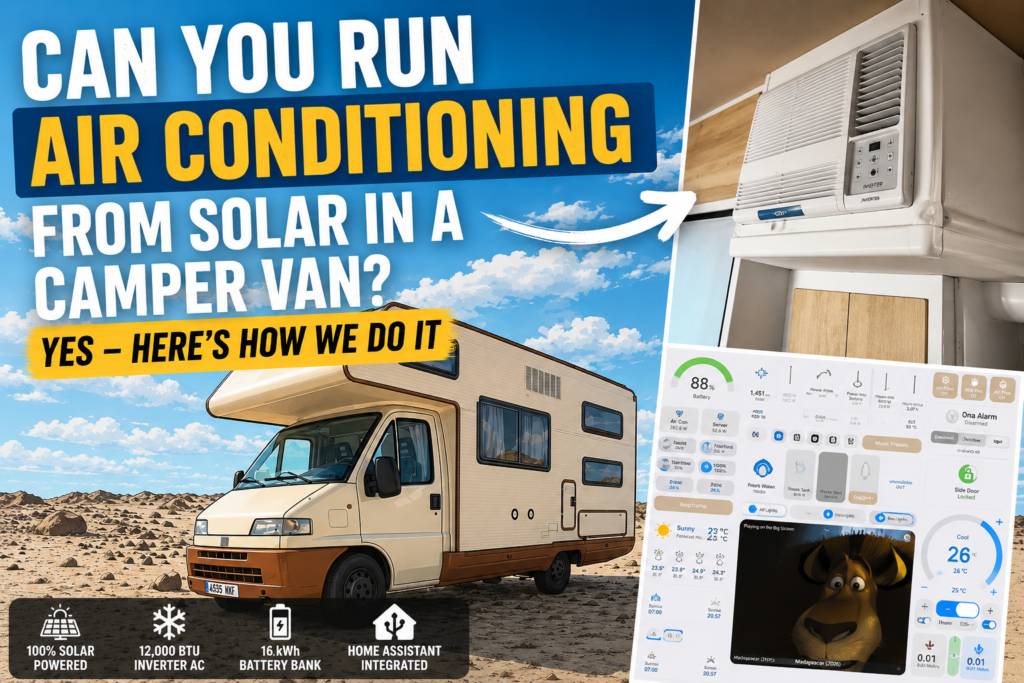
On a typical summer day in Spain we cool the van from late morning until around 10 pm while still charging our batteries back to full.
No campsite.
No generator.
No hook-up.
No compromises.
Getting here wasn’t cheap, and it certainly wasn’t easy, but after years of trial and error I finally have a system that works.
Now let me explain how we got here.
In this article you’ll learn:
- Why two popular portable air conditioners failed to cool our camper.
- How we built a 100% off-grid air conditioning system.
- How much power our 12,000 BTU unit really uses.
- Whether solar can genuinely run air conditioning.
- The exact battery and solar setup that makes it possible.
Introduction
For me, van life has always been about following the sun. Enjoying the beach as your garden, all the extra outside space and the sun shinning down is one of the main reasons I love van life. After more than six summers living in camper vans across Spain, I wouldn’t swap it for anything.
But having built 2 vans and spending more than 6 summers in Spain living in vans I do understand why many people head to cooler places for the hottest months.
For me, these are the best months, enjoying the sea when it’s warm and living without the need for t-shirts is my thing. However, every time we got back to the van, it wasn’t so pleasant. I can remember multiple occasions getting back to our first van and it being well over 40°C inside! I remember opening the van door and being hit by what felt like an oven. The tap water was hot enough that you didn’t need to boil it for washing up, and even at 11 pm it could still be too hot to sleep. More than once we ended up running into the sea late at night just to cool down before bed.
Attempt 1 – Zerobreeze Mk2
So our second conversion was going to be different, I had watched so many YouTube videos and concluded that a ZeroBreeze MK2 portable air conditioner would be perfect, I even split the output to cool both our electrical storage cupboard and the van thinking this would be smart.
In reality all the air conditioner did was keep our electrics cool, this was good, our batteries never sat in 40°C heat everything had a nice cool breeze keeping them from overheating and shutting down, but the temperature in the van itself… Didn’t even go down by a single degree. Maybe it stopped it getting even hotter, but if it was 30°C outside, then it would still be 35°C inside.
Attempt 2 – EcoFlow Wave 3
So we had to make a change, we doubled the BTU rating as everybody was now saying how great the Ecoflow Wave 3 Portable Air Conditioner was. Unfortunately, the result was almost exactly the same, it still didn’t cut it. For sure it made a difference and if you were to stand closer to the unit itself then you could definitely feel the cooler air, but again, maybe the temperature inside the van was still a degree or 2 higher than the outside temperature.
And the thing is both these units used around fair amount of power, the Ecoflow used around 700 W on max and for the output, it needed to sit on max basically all the time.
So for our current van I knew we needed to do something different.
Whenever you search, most people will tell you that Air Conditioning cannot be done without a hook up or generator of some sort, just solar is not enough. At least the people that tell you this are aware that for a camper van / RV you need at least 10,000 BTU’s to actually be able to cool the van. Of course this depends on many conditions, but assuming around a 6 or 7m camper van, parked in the sun (so you get solar) you will need 10,000 to 12,000 BTU’s to efficiently cool the van.
But I was determined to put the right system together to finally get a working setup.
Why We Decided To Install Air Conditioning
Of course there is the most obvious reason we wanted Air Conditioning in the van, we are now a family of 4, kids need their sleep, we can be hanging around outside till midnight just because it is too hot inside the van, the same is also for the middle of the day, when the sun is its strongest and after being out all morning we like to have lunch and do some indoor activities with the kids to stop them getting burnt in the strongest hours, if we choose to be inside from 12-3pm it is essential on a hot sunny day that we can cool the van down, again if we cook, use the projector to watch a movie – these things generate a lot more heat, so without air conditioning we would easily get way to hot and it would just be very uncomfortable.
We also both work from the van, so even if the kids are out and we can maybe tolerate a slightly higher temperature, if we are trying to work, it just makes it very awkward. If you’ve ever tried to work inside a 30°C office, you’ll already know how difficult it is to concentrate.
Attempt 3 – Household Mini Split
So after using the portable units in our last van I knew they were not an option in this van, I wanted to fit a standard household mini split system, they are not very expensive, most come with a heat pump, they run on inverter technology so are very efficient and the big noisy part can be outside the van and not taking up space inside. However, I could not find a way to get this type of unit legalized on our van where we live, most people told me it is absolutely impossible, others told me there are ways that it can be done, but it is not easy and I just did not want the trouble of not being able to legalize the final setup. Also to install or remove them ideally needs a professional with the relevant tools, so this adds to the cost. And a final nail in the coffin for the mini split for us, we didn’t actually have anywhere that it would fit on the inside of the van, so we would have had to remove storage to make it work anyway.
Attempt 4 – Household portable tower unit
So at the last minute I found a portable Air Conditioning unit, one of the big tower units on wheels that ran on the same inverter technology as the mini splits, I had also researched before that it is possible to upgrade these units by adding an additional hose to the outside to make them work as they should with the compressor side simply moving fresh air from the outside over the compressor and blowing the now hot air back outside. And as for the other side of the unit, it takes the hot air from the inside and cools it and blows it back inside. I hoped this unit would work for us, and as I was building the van in the middle of the Spanish summer, in the south of Spain, it was the perfect time to test it.
And unfortunately it just did not work, I tried a few tricks to make it cool more efficiently, but it just could not keep up, despite being advertised as 12,000 BTU’s.
Attempt 5 – RV Roof Mounted units
My other option was a standard RV roof mounted unit, the problem with these, in Europe we pretty much only have the main branded models: Dometic, Truma etc… and they are expensive, like 2,000 EUR or more. The other issue, they take up a huge amount of roof space, and for me every square centimeter of roof is reserved for solar panels..
Final attempt: The Air Conditioner We Chose
So the final option and one that somehow seems much harder to come across here in Europe – an American style window unit.
These units are basically mini splits, but rather than being ’split’ they are joined together, half is supposed to hang out your apartment window and the other half moves and cools the air inside the room.
These units come with modern inverter technology, are available in 12,000 BTU models (and larger), and some even include a heat pump.. So how can I make this work?
Well I have 2 options, fit it on some form of a slider so I can ‘slide’ it half way out the camper when we want to use it… I can just picture the leaks thinking about it again!
Or
I build a fake insulated wall on the inside of the camper, cut a big hole in the side and put some standard large vents, so now I have an ‘outside area’, inside my camper, then fit and seal the unit in place so the part that should be hanging out is fully ventilated to the outside air. And the part that is on the inside, well its on the inside.
I underestimated the weight of the unit… and to be the most efficient I wanted it fitted high up on the ceiling, so this created some engineering to come up with a strong and safe structure to ‘float’ it in the air.
But in the end…
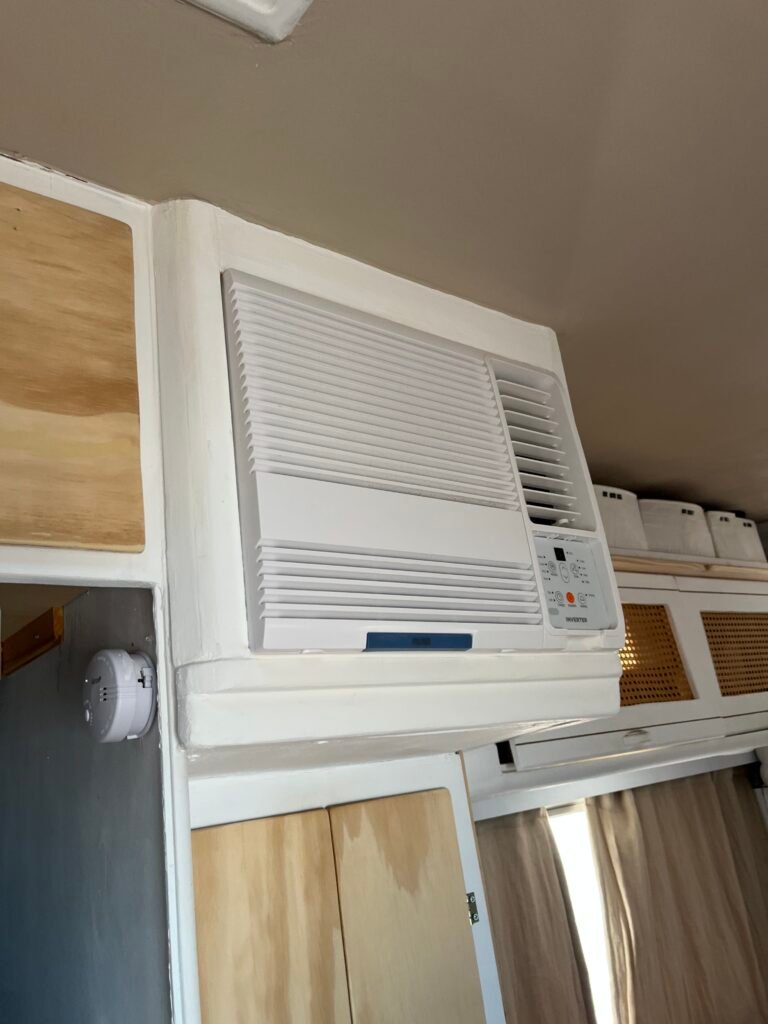
Our finished installation. The air conditioner is mounted high to capture the hottest air naturally rising through the van while the rear section is completely isolated from the living space and vented outside.
we have a 12,000 BTU Air Conditioner with inverter technology that has the most efficient air flow sucking the rising hot air from the ceiling of our camper, cooling it and pushing it out while swinging left and right from the middle of the van to ensure the whole van is cooled, meanwhile the outside air is being pulled over the compressor and blowing the now hot air back out, no negative pressure, no inefficiency of pulling air you just cooled and throwing it out the van, just a super efficient unit.
- Without outdoor unit
- Easy to apply
- No fluid handling
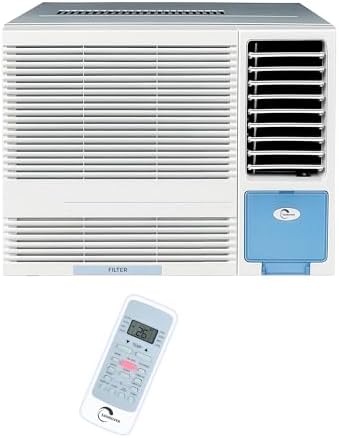
Note: This is the exact unit I use. Availability varies by country. Mine was imported from France and should be available throughout most of Europe. However, there are several similar inverter window air conditioners that perform just as well. The important things to look for are around 12,000 BTU, inverter technology, and low running power, rather than this exact brand.
If you’re reading this from the US or Canada, you’ll probably already have access to several similar options, often at a lower price.
If you’re in Europe and can legally install a household mini split, I’d also highly recommend considering that route. A good inverter mini split will offer very similar efficiency, with a wider choice of models and often a lower purchase price. Just keep in mind that professional installation may offset some of those savings.
If you’re unsure which type of unit would work best for your setup, feel free to get in touch—I’m always happy to help.
The Electrical System Behind It
Now, it is still a 12,000 BTU unit, so when it needs full power it still uses around 1,200 W. And most camper vans do not have this much solar, and the ones that do, well you need to power more than just the Air Conditioner, so this is where it gets tricky.
As I mentioned above, I filled my roof with solar, I have a total of nine 210 W panels, giving me 1,890 W of power. On clear days with full sun I will pull around 1,600 W from these panels, they are not tilted, facing the sun and although raised a little off the roof, they do get hot that lowers the efficiency, so just keep this in mind that on an RV you will struggle to get as close to the full output of your solar panels as the conditions are not ideal. This being said, at some points mid morning or mid afternoon when everything aligns perfectly and the panels have been in the shade for example I have actually managed to get over 1,900 W from the panels.
So usually before 10 or 11am wherever we are we do not need the Air Conditioning, as the van starts to warm up close to midday we turn the AC on as the van is not 30°C + it does not take much to cool down, maybe 10 minutes of around 700 W then once it has reached the temperature the power consumption will drop down to around 200-400 W depending on how hot it is outside. So like this we have plenty of solar left over to make sure we charge our batteries back up, can use the air fryer for lunch, put the electric water heater on and enjoy listening to music or watch a movie at the same time.
On particularly hot days, we will keep running the air conditioning till around 10pm to make sure that the van stays below 24°C and the kids are sleeping comfortably, usually by 10pm the temperature outside has also dropped enough that just opening the roof vents maybe with the fans is more than comfortable.
So assuming we have used the air fryer to cook dinner and the air conditioning for around 3 hours with no solar input, our batteries will be on around 85% before we go to sleep, our batteries are 16 kWh meaning we will have around 2,5 kWh to recover with solar the next morning. Including our normal overnight usage, we usually wake up somewhere around 75% state of charge, meaning we only need to recover around 4 kWh the following day. As I said, we do not usually need the Air Con before 11am, and from 9 or 9:30am we are getting over 1,000 W from the solar, so we get pretty close to full before we even need to turn the Air Conditioning on. Then by midday when the Air Con is on and maintaining temperature it will be using around 350W at this point we will be getting over 1,500 W from the solar, so enough to run the Air Con & everything else plus put enough power back into the batteries to get them back to full later in the afternoon.
If you want to know more about the rest of the electrical system you can find more information here below, unless you only wish to use the Air Conditioner when you are at campsites and plugged in, I think you will find the details of my system interesting.
[Read: My 48V Camper Van Electrical System →]
Can Solar Really Power Air Conditioning?
My definitive answer: absolutely, and don’t let anyone tell you otherwise. Our solar runs our Air Con, Air Fryer, Water Heater, 4K projector, Surround sound, 24/7 Server and more… If you don’t need half these things, or even just remove or limit the use of the Air Fryer, then it is very possible to run Air Conditioning that actually works from solar.
The use cases are always very unique, but you have many easy options to make it more manageable. For example, if you live somewhere that you can go and hook up whenever you need, eg. A campsite or friends house etc… then you can comfortably run your batteries as low as you like knowing you can get them charged back up easily the next day if needed.
If you have a powerful alternator combined with a high wattage DC to DC converter, then you have the chance to either recharge your batteries by going on a long drive, or if you know your Air Conditioning is going to need to work hard to get the high temperature in the van down, for example if you have let it get above 30°C and you set the Air Con to 25°C then it is going to be using over 1,000 W for probably 20 minutes or more, for this you could start the van and use the engine to effectively power the Air Conditioner for all or some of this time, then once the temperature has been lowered and the inverter of the Air Conditioner unit turns itself down, at this point if you are only needing 300 or so Watts, at this point you could run your Air Conditioner with maybe even just 600-800 W of solar on the roof…
So there are many easy ways to run Air Conditioning off smaller solar systems, if you have other means of charging your batteries back up.
If however like us, you spend a lot of time somewhere that doesn’t have any campsites (right now we are in Fuerteventura and there are no options to plug in and charge up). And although we have an alternator charger, the max power we can put into our batteries from the engine is 700 W – So if we completely drained our batteries it would take over 20 hours driving to get them charged back up, not including any power we use during this time, so in reality probably 30+ hours.
So for us we had to go for a big solar setup to cover us no matter where we are. Our back up here is 600 W of folding solar panels we can put outside the van, this can give us the boost we need if our batteries ever get too low. But our batteries are our main savior. With 16 kWh as I said above we can run the Air Conditioning till midnight if we needed and our batteries would still only drop to around 70% the next morning before the sun comes up and starts charging back them back up. If the next day then happened to be very hot but cloudy we would probably wake up the next morning on around 50% with our system we could happily have a few days like this before needing to start worrying about not using the Air Fryer or maybe not having the hot water so hot etc… and after 2-3 days like this assuming a clear sunny day comes we can connect the portable solar panels and would likely just need the one full day of sun to get back to 100%
Real Power Consumption
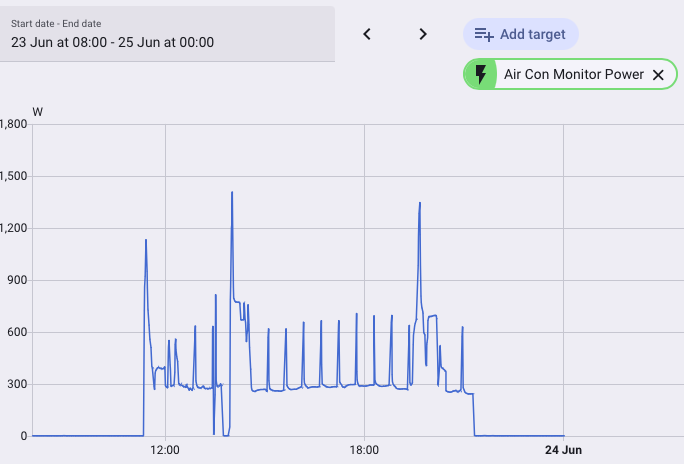
On a typical hot day here in Spain with outdoor temperatures around 28-29°C throughout the day, we will need to turn the Air Conditioning on around 11am, we will have an initial spike of power, almost 1,200 W to get the van to around 24/25°C. Then it will use between 250W & 600W on and off throughout the day with spikes usually while cooking or maybe if we have left the door open for a little while getting the kids in and out etc.. If we turn it off around 10pm then in total for the day we are looking at between 3,0 kWh and 4,2 kWh
Air Con Power usage through the day:
Home Assistant & Sensibo Integration
Home Assistant allows me to automate the entire system, monitor temperatures remotely and control the air conditioner from anywhere. Sensibo is the smart bridge that allows Home Assistant to talk to my Air Conditioning unit.
[Read: How I Use Home Assistant In My RV →]
Remote Control From Anywhere
A quick note on being able to control the Air Conditioning / Sensibo from anywhere is you need internet in your van, you can read more about this here.
[Read: Best Internet Setup For Full-Time Van Life →]
Is Air Conditioning Worth It In A Camper Van?
After living with proper working air conditioning for the past year, I honestly wouldn’t build another full-time camper van without it.. There are so many circumstances that Air Conditioning just makes sense.
- If you are near a beach, even if it is not that hot having to have all the windows open can cause other issues… anyone who has been to morocco or the Canary Islands has probably experienced the sand and dust that seems to fill your van instantly.
- Anyone with kids or pets know that they need to be able to be out the sun and out the heat, they can’t be in the hot sun all day even if they can jump in the sea to cool down.
- Sleeping at night/getting to sleep, even just as a couple without kids I can remember the sleepless nights as having the windows open and fans on where just moving 30°C+ air around making it impossible to sleep.
- Working, it is such a pleasure to be able to sit and work in a comfortable temperature, it is also very handy for calls or meetings if you do not need fans and windows open causing all sorts of background noise.
So my advice is find a way, I have given many examples above of ways to run your Air Conditioning from Solar even if you cannot afford, fit or want a massive solar setup.
Our Current Air Conditioning Setup
| Component | Specification |
| Air Conditioner | 12,000 BTU inverter window unit |
| Battery Bank | 16 kWh LiFePO₄ |
| Fixed Solar on Roof | 1,890 W |
| Portable Solar | 600 W |
| Voltage | 48 V |
| Typical Consumption | 3–4.2 kWh/day |
| Cooling Temperature | 24–25°C |
| Runtime | Late morning until around 10 pm |
Can a camper van run air conditioning from solar?
Yes. If your electrical system is large enough. Our 1,890 W solar array and 16 kWh battery bank comfortably run a 12,000 BTU inverter air conditioner throughout the day while still recharging the batteries
How many solar panels do I need to run an air conditioner?
It depends on the size of the air conditioner and battery bank, but for full-time off-grid use I would recommend around 1,500-2,000 W of solar if you want to cool a camper throughout the hottest part of the day.
Is a portable air conditioner worth it?
In my experience, no.
After trying both the ZeroBreeze MK2 and EcoFlow Wave 3, neither was capable of properly cooling the entire camper during Spanish summers. They worked, but they simply didn’t move enough heat.
What size air conditioner do you recommend?
For a typical 6-7 metre camper van I’d recommend around 12,000 BTU with inverter technology.
It cools the van quickly before reducing its own power consumption, making it surprisingly efficient once the desired temperature has been reached.
How Much Did It Cost?
| Main Items | Approximate Cost |
| Air Conditioner | €600 |
| Solar Panels | €1,000 |
| Batteries | €1,600 |
| Smart Inverter/MPPT | €500 |
| Sensibo | €100 |
| DIY Fitting | €50 |
| Total | €3,850 |
There are many different options available here, and you may already have parts of the system, so the cost to you could be very different. For example if you can fit 3 or 4 large 500 W+ panels on the roof of your van, you can find efficient panels of this size for less than €100 each, so a massive €600 or more saving on solar panels alone for the same or more power.
What I Learned After Three Air Conditioners
✔ BTU matters, a good inverter type A/C unit with 12,000 or more BTU’s will use less power than a 7,000 BTU unit – why/how?? A 12,000 BTU unit will pull more power to start, but will actually get the van to the desired temperature, then it will use less power to maintain it rather than a 7,000 BTU unit probably working on max for hours trying to get the temperature down and not succeeding.
✔ Small portable air conditioners, even with inverter technology often struggle to cool an entire camper van, even when the advertised BTU figures look impressive.
✔ Inverter compressors are worth every penny.
✔ Don’t underestimate airflow & positioning.
✔ Cooling early then maintaining uses less energy than cooling a 35°C van.
✔ Bigger batteries are often cheaper than replacing the wrong air conditioner. If you can add more batteries, more solar or more ways to get power it is 100% where you should focus. Buy smaller portable units or underpowered cheaper units will cost more in the long run. And spending 2,000 EUR + on a Dometic unit when you can get a mini split or window Air Conditioner unit for less than a quarter of the price… spend where it will make the difference.
It’s just Cool…
After years of trying different solutions, spending money on systems that didn’t quite work and constantly tweaking the setup, we’ve finally reached the point where our camper stays cool all day using nothing more than sunshine.
For me, that’s one of the most satisfying parts of the whole build.
There’s something incredibly rewarding about sitting inside a cool camper on a 30°C summer afternoon, knowing that the very sun making the outside unbearable is also powering the system keeping us comfortable.
That’s when it really feels like you’re winning at van life.
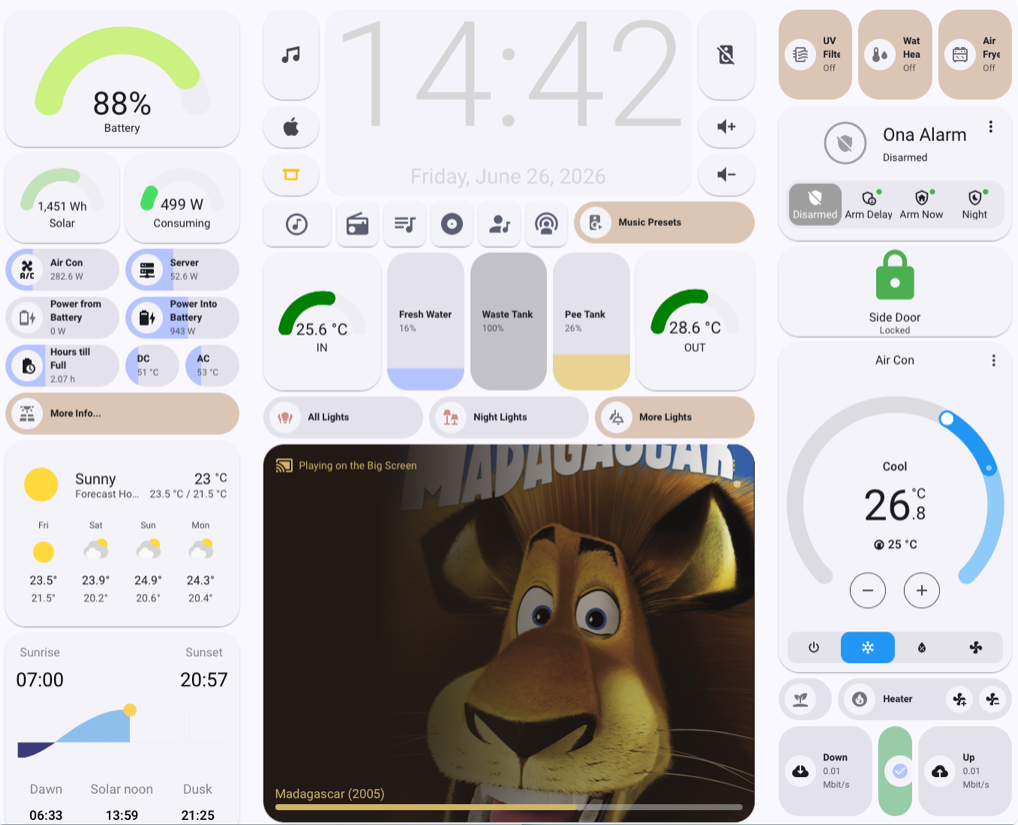
Today’s example… We ran the Air Con till late last night as it was hot, so we started the day on 73% SOC. By 14:24 we were at 87% even after using the Air Fryer to cook lunch, listening to music all morning, and with the kids watching a movie in the middle of the day to escape the extra hot sun.
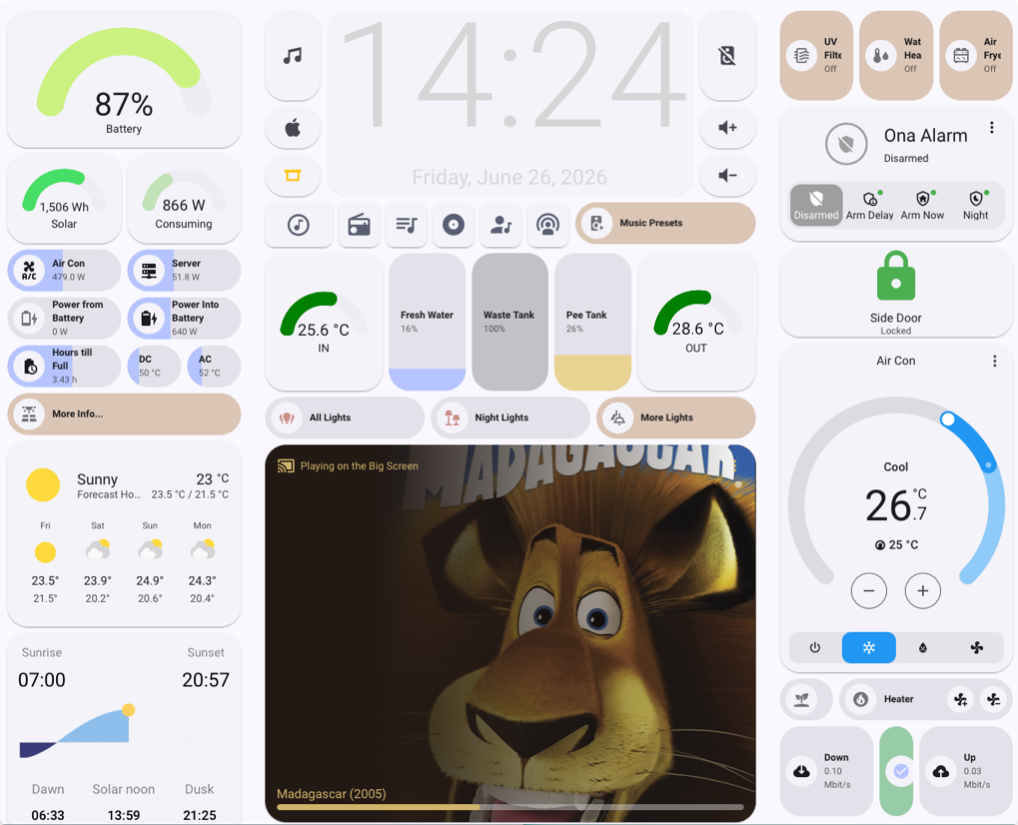
Just 20 minutes later and we can see the consistency. The temperature in the van is being maintained at 25.6°C – it’s really bad timing that my outdoor temperature sensor has decided to go offline… but it has been around 28 all day here. (I can upload new screenshots tomorrow as the outdoor sensor has now been reset and is back online). But you can see at 14:24 the compressor kicked in a little to add a little more cooling power and used 479 W, at 14:42 it was already back to a lower consumption and just sipping power at 282 W. In both these images you can see at this rate, even with watching the movie that includes a little extra power from the server, the 4K projector running at full brightness as we don’t want to have to make the van pitch black just so the kids can watch, the surround sound being on, all this including the A/C is using between 450 W and 900 W. And the time till full indicator for the batteries moving between 2-3 hours, And once the movie was finished this time was cut in half.

Hi, I’m Luke.
I’ve personally renovated three camper vans from the ground up, including complete electrical systems, plumbing, solar, networking and smart automation.
This website documents my latest project: building one of Europe’s most advanced smart camper vans.
About me | Consultation Service | Work with me

Pingback: The Ultimate Driving Dashboard – LTH Media